Returning home after even short trips involves a protracted period of unpacking, a process that takes longer than necessary and almost always leaves items tucked away in some random, travel-related corner. The small bag I use to carry around toiletries is a witness to this process, constantly half loaded for the next trip as it gets stowed awkwardly behind other, more pressing items underneath the cabinet. As kids my brothers and I were expected to have our bags ready when we headed out the door to the beaches of Tybee or the mountains of Helen. The reminder came from both our parents, but only my Dad used a term that referred specifically to this item, which he generally uttered as a matter of expediting our exit. “Make sure you knuckleheads have your drop kits”, he would say and we would dutifully check that everything was in order.
It’s unlikely that I’m accurately representing this exchange with my Dad (my brothers would agree); however, he most certainly used the phrase “drop kit” to describe the small bag one used to carry around toothbrushes, combs, and the like. It wasn’t until I was in graduate school traveling with a friend that I came to learn the truth about this phrase. We were in a hotel in the Dominican Republic, and, as he asked if he might borrow a nurdle of toothpaste (he had a way of introducing words I’d never heard), I pointed him towards my suitcase, saying that it was in my “drop kit.” He was briefly confused, presumably trying to determine whether he should correct me. After a moment’s deliberation, he chose to do the right(?) thing and proceeded to explain to me that I’d misused the phrase; it was “Dopp kit”. This was not our first lexical skirmish as we were just recovering from a heated conversation over the origin of the phrase “brownie points” (still unresolved, by the way). And, not having instant access to an answer in 2000, I set aside my confusion and followed up later. As it happens, he was correct (which was usually the case). The Dopp kit was introduced in the 1920s by leather craftsman, Charles Doppelt. The term was popularized during World War II.
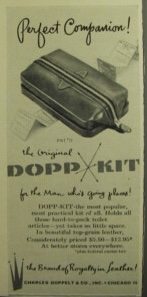
My Dad, a baby boomer who would likely have been exposed to this item and its name in the 50s, would go on to reinvent it, creating a sort of eggcorn presumably based on the idea that a one might gather toiletries to be used on the road and quickly, or at the drop of a hat as it were. I’m speculating on the source of this, of course, but the explanation is, I think, reasonable. Curiosity lead me to consult the enTenTen21 corpus on SketchEngine, with its 52+ billion words reprenting a wide swath of the English speaking world.
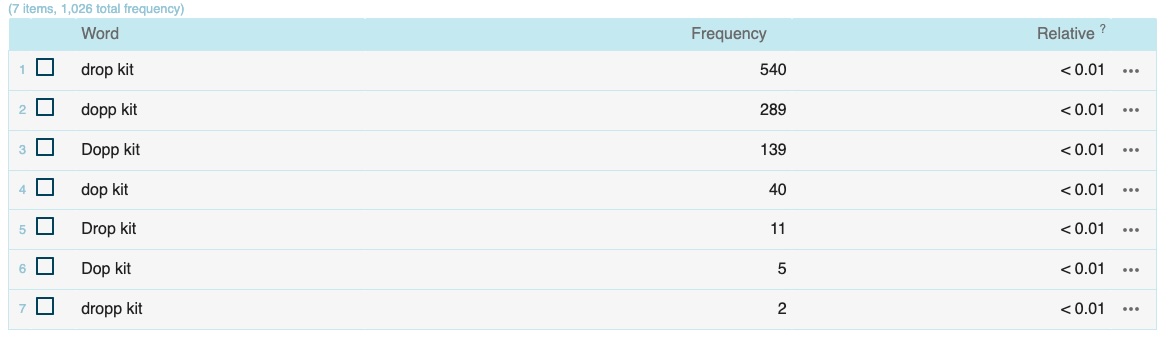 Results for “(D|d)r?opp? kit” in esTenTen21
There are a few notes related to these examples. First, in addition to it reference to toiletries, shown in (1) below, the term “drop kit” is also, and more freqently, used to describe a device that allows you to lower a vehicle’s suspension (think lowerider), illustrated in (2). There’s apparently also some use of this term that refers to swimming pools. The example in (1) refers to a purple hair dye kit and, as is probably obvious, was extracted from a site from the UK. Since Doppelt was German-American, perhaps we can assume that the Dopp kit spread from the US to the UK, and, as these things so often do, parallel processes of folk etymologizing ensued.
- The drop kit allows you to experiment with colours to find your favourite shades, so you can unleash your inner artist at home
- Future mods include a light bar, roof cage and I’m going to put on 33s and a diff drop kit.
What’s more interesting, at least for me, is that the results for “drop kit” are populated almost exclusively by examples relating to vehicle modifications (or pool maintenance), an outcome that makes me smile thinking that my Dad’s reinvention of the term may have been idiosyncratic. The other renderings display a more expected distribution, with “Dopp kit” (or “dopp kit”, presumably a genericized form) referring to a toiletry bag, often bespoke and rugged, marketed to men to make it clear that they should never miss an opportunity to reinforce their masculinity. As a quick aside, it would appear that the “toiletry bag” vs. “Dopp kit” distinction is based (a) on the material used for the product (e.g., plastic vs. leather) and (b) the target consumer audience, which I guess could be viewed as a single reason.
- Everything is packed in a water-resistant Dopp kit that’s super tough and made from Italian-milled fabric.
- So I go from thing to thing like any actor does, with my little bag, my dopp kit. (uttered Meryl Streep in an interview)
My favorite pair, provided in (5) and (6), suggests that the divide between toiletry bag and vehicle modification enthusiasts is not as wide as you might expect, though it may be that there’s more than a little overlap in the the venn diagram for these groups.
- Install rear carrier bearing dropp kit and hopefully new carrier bearing 30.
- Crafted by designer Stephen Kenn in Downtown Los Angeles (whose backpack I featured here and whose weekend bag I feature here), this dropp kit is made using super soft, oiled vegetable tanned leather on the outside and features an olive green waxed interior
For my part, I’ll continue to use the phrase “drop kit”, in part just due to shear inertia but also because it feels like a modest homage to both my parents and to Charles Doppelt whose name persists with this product, albeit in a way that gives us a glimpse at the true ingenuity of human language use and perception. Were I the entrepreneurial type, I might start a line of toiletry bags called “drop kits”, explicitly marketed at consumers for whom carrying around a toothbrush is less of an opportunity for personal branding and more of a response to basic oral hygene. Keep checking this blog; I expect a product launch in the not-so-distant future.